

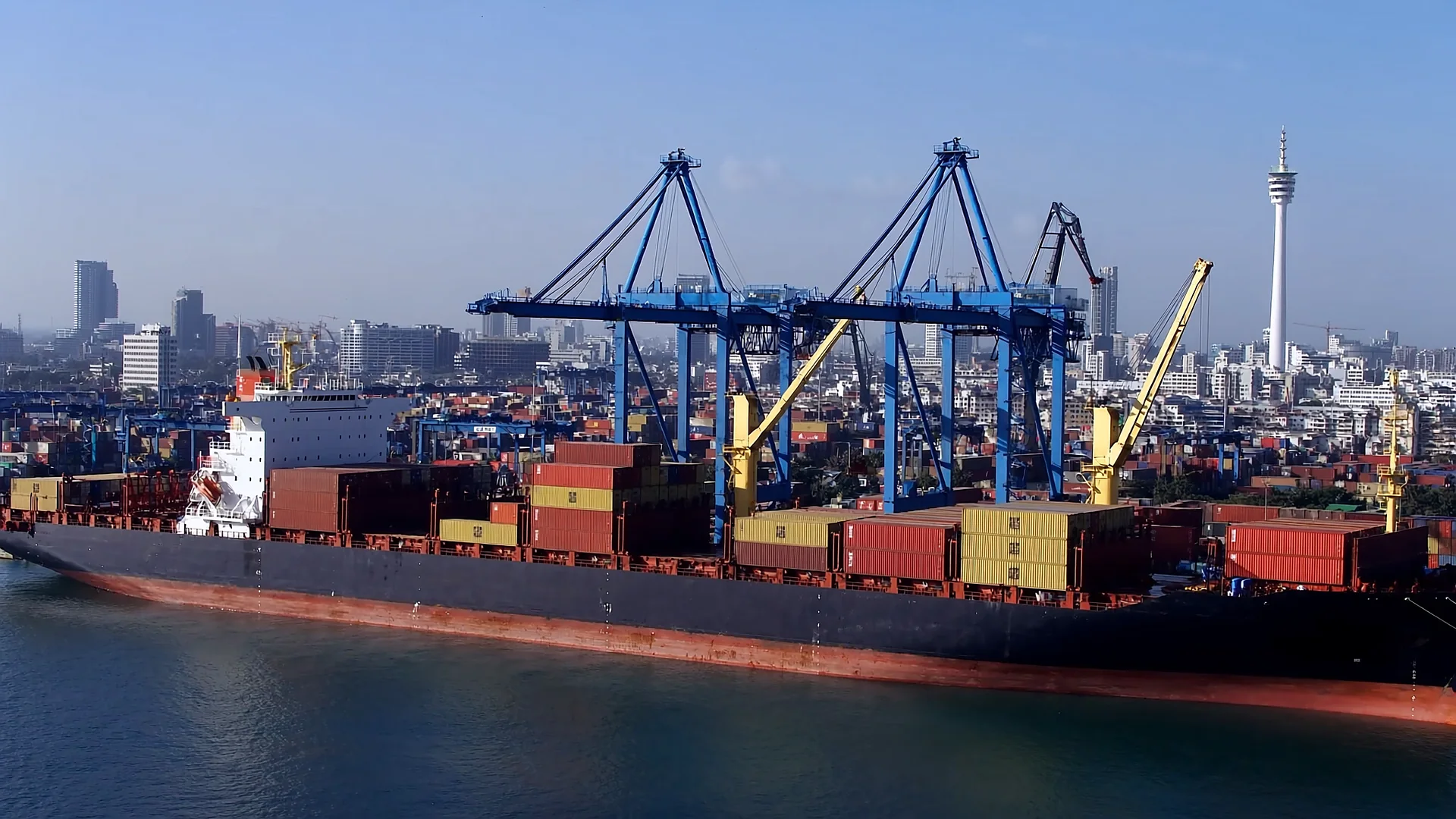
A ship is arrested in Sri Lanka by filing an action in rem in the High Court under the Admiralty Jurisdiction Act and obtaining a warrant of arrest under section 7. The claim must fall within section 2(1), and the ship is released against security.
The Port of Colombo handles a large share of the containers moving through the northern Indian Ocean, much of it transshipment cargo that never leaves the terminal. For a creditor with an unpaid maritime claim, that traffic is useful. If the debtor's vessel calls at a Sri Lankan port, and the live maritime tracker shows what is off Colombo, Galle and Trincomalee now, its presence in the jurisdiction can be used to obtain security through arrest. The maritime tracker follows vessel movements around the island for that reason.
Admiralty jurisdiction in Sri Lanka
Admiralty jurisdiction in Sri Lanka comes from the Admiralty Jurisdiction Act No. 40 of 1983, which came into operation on 12 October 1983. Section 13(1) of the Judicature Act No. 2 of 1978 vests admiralty jurisdiction in the High Court and provides that it is ordinarily exercised by a judge sitting in the judicial zone of Colombo. It is exercised by the High Court of Colombo, and the procedure is set out in the High Court (Admiralty Jurisdiction) Rules of 1991, published in Gazette Extraordinary No. 672/7 of 24 July 1991. The Commercial High Court of Colombo lists admiralty actions in rem among the matters it hears. Together the Act and the Rules let a claimant bring an action and, in the right case, arrest the ship the claim relates to.
Section 2(6) applies the jurisdiction to all ships whether registered in Sri Lanka or abroad and wherever their owners reside, to all claims wherever arising, and to all mortgages and charges, including those created under foreign law. Section 12 provides that where the Act and the Rules make no adequate provision on a point of procedure, the court may make the orders an admiralty court in England could make. Section 9 makes the Director of Merchant Shipping the Marshal of the court, acting under the directions of the admiralty judge.
The action in rem
The defining feature of admiralty practice is the action in rem. This is an action brought against the vessel itself as a legal defendant, not only against the shipowner in person. Because the ship is treated as answerable for certain claims connected to it, a claimant who could never realistically sue the owner in Sri Lanka can still gain leverage by detaining the asset while it sits in port.
Section 3 sets out when the action is available. Section 3(2) allows an action in rem against the ship or property for the ownership, co-ownership, mortgage and forfeiture claims in paragraphs (a), (b), (c) and (r) of section 2(1). Section 3(3) allows an action in rem wherever there is a maritime lien or other charge on the ship for the amount claimed. Section 3(4) covers the commercial claims in paragraphs (e) to (q). It opens a two-stage test: the claim must arise in connection with a ship, and the person who would be liable in personam, the relevant person, must have been the owner or charterer of that ship, or in possession or in control of it, when the cause of action arose.
What the subsection then does with that test is, remarkably, not something the published texts answer. In the Act as reproduced by the Director-General of Merchant Shipping, and in the consolidated versions that circulate online, section 3(4) stops after paragraph (b) and runs straight into subsection (5). The operative words that should say which ship may be arrested once the test is met are simply absent. This matters because those are the words that would or would not authorise the arrest of a sister ship, and practitioners writing on Sri Lankan law take opposite positions on whether the Act permits one at all.
Two things can be said with confidence even so. The first is that section 3(7) presupposes it. That subsection provides that once a ship has been served or arrested in an action in rem on a claim, no other ship may be served or arrested for that claim, while expressly preserving the issue of a writ naming more than one ship, or of several writs each naming a different ship. A prohibition on arresting a second ship, and a saving for writs that name several, would be pointless unless more than one ship could be a candidate. The second is that section 3(6) directs that, for the purposes of subsection (4), the relevant person is assumed to have a habitual residence or place of business in Sri Lanka, which is the machinery of an ownership-based test rather than a purely offending-ship one. Anyone proposing to arrest a ship other than the one the claim arose on should nevertheless work from the Gazette text obtained from the Government Printer rather than from any version available online.
Which claims qualify
Not every commercial grievance will support an arrest. Section 2(1) of the Act sets out the maritime claims that in rem proceedings can be founded on. These include goods and services supplied to a vessel, such as bunkers, stores and repairs, unpaid crew wages, claims under a charterparty or a contract for the carriage of goods, damage done by a ship, and salvage, towage and pilotage. Whether a particular debt falls inside the section is often the first question counsel has to answer.
| Claim | Paragraph of section 2(1) | Action in rem |
|---|---|---|
| Possession or ownership of a ship; disputes between co-owners; a mortgage of or charge on a ship | (a), (b), (c) | Against the ship, section 3(2) |
| Damage received by a ship | (d) | In personam, or in rem only where a maritime lien or charge exists, section 3(3) |
| Damage done by a ship, including pollution liability under section 2(4) | (e) | Section 3(4) |
| Loss of life or personal injury caused by a defect in the ship or the fault of those operating her | (f) | Section 3(4) |
| Loss of or damage to cargo; any agreement for carriage of goods or the use or hire of a ship | (g), (h) | Section 3(4) |
| Salvage, towage and pilotage | (i), (j), (k) | Section 3(4) |
| Goods, materials or services supplied to a ship; construction, repair, equipment, dock charges or dues | (l), (m) | Section 3(4) |
| Wages of the master and crew; disbursements by a master, shipper, charterer or agent | (n), (o) | Section 3(4) |
| General average and bottomry | (p), (q) | Section 3(4) |
| Forfeiture or condemnation of a ship or goods, restoration after seizure, wreck and derelict | (r) | Against the ship or property, section 3(2) |
Maritime liens and priority
Maritime liens are defined not in the Admiralty Act but in section 83 of the Merchant Shipping Act No. 52 of 1971, which lists five: wages and other sums due to the master, officers and crew; port, canal, waterway and pilotage dues; claims for loss of life or personal injury in direct connection with the operation of the ship; claims in delict for loss of or damage to property in direct connection with the operation of the ship; and claims for salvage, wreck removal and general average contribution. Because a lien attaches to the ship, section 3(3) allows an action in rem against her without the ownership condition in section 3(4).
Section 84 gives those liens priority over mortgages and registered preferential rights, and section 85 ranks them in the order listed, with salvage, wreck removal and general average liens taking priority over liens that attached earlier. The claims in paragraphs (a) to (d) rank equally among themselves; those in paragraph (e) rank in the inverse order of when they accrued. Section 86 completes the picture at the yard's expense: a shipbuilder's or repairer's possessory preferential right is postponed to every lien in section 83, and takes precedence only over a mortgage or other right registered under Chapter 4, and only for as long as the ship stays in its possession. Where the court orders a sale, section 3(5) of the Admiralty Act gives it jurisdiction to decide title to the proceeds, and that ranking decides who is paid first.
How an arrest is carried out, step by step
The mechanics are demanding, and the sequence below is the one the Act and the Rules contemplate.
- Confirm that the claim falls within a paragraph of section 2(1) and identify the in rem route under section 3, including, for section 3(4) claims, that the relevant person controlled the ship when the cause of action arose and is the beneficial owner or demise charterer at the time the action is brought.
- Identify the target vessel and confirm her expected port call, so that the papers are filed before she berths.
- Prepare the proxy for the instructing attorney, the plaint or writ in rem, an affidavit setting out the claim with every supporting document, a motion for the warrant, and a draft warrant addressed to the Marshal.
- File the action in the High Court of Colombo exercising admiralty jurisdiction, stamped under section 10 in accordance with the Stamp Duty Act No. 43 of 1982. The application for the warrant is made without notice to the owner.
- Satisfy the judge, under section 7(1), that the vessel will be removed out of the jurisdiction before the claim is satisfied. The judge may then issue a warrant for the arrest and detention of the vessel.
- The Marshal executes the warrant, and the port and terminal are notified so that the vessel is not cleared to sail.
- The defendant, or anyone who has entered an appearance, applies under section 7(2) for release by paying into court the amount claimed or the appraised value of the vessel, or by giving bail, a guarantee or other security to the plaintiff's satisfaction. Section 7(4) lets the judge reduce or increase the amount.
- Once security is in place the vessel is released and the action continues on its merits, with costs, charges and fees under section 8. Property subject to speedy decay may be sold under section 7(3) and the proceeds held in court.
- If the claim succeeds and is not paid, the security is called or the vessel is sold and the proceeds distributed according to the priorities above. Appeals lie to the Court of Appeal under section 13(3) of the Judicature Act.
The Rules themselves are worth naming by number, because the reported authority does so. In MV "Kalyani" v Mutiara Shipping Company [1998] 2 Sri LR 105 the Supreme Court described the action as instituted by issuing a writ of summons under rule 4, with the plaintiff applying at the same time for and obtaining a warrant for the arrest of the vessel under rule 25. The same judgment refers to rules 141 and 145, which provide for a caveat against arrest and re-enact rules 159 and 163 of the English Admiralty Rules of 1883.
That caveat deserves more attention than it gets. An owner who expects a claim, and would rather post security than have a vessel stopped, can enter a caveat against arrest with an undertaking to acknowledge service and give security, so that an arrest is at least contestable and the commercial damage of a detention is avoided. For a liner operator on a fixed rotation through Colombo, the arithmetic usually favours the caveat over the alternative.
Security and release
Section 7(2) gives the defendant two ways out: payment into court of the amount claimed or the appraised value of the vessel, or bail, a guarantee or other security to the satisfaction of the plaintiff. In practice the security is usually a bank guarantee from a bank subject to Sri Lankan jurisdiction, covering the claim with interest and costs. Because the statute makes the security's acceptability a matter for the plaintiff, a letter of undertaking from a P&I club will release the ship only if the claimant agrees to accept it, and owners should expect to be asked for a bank guarantee where the claimant insists. The Act does not require counter-security from the arresting party; it places the burden of securing release on the defendant.
Timing, limitation and wrongful arrest
Timing is the practical difficulty. A port call may last only hours, so the papers have to be in order before the ship berths. The claim needs to be documented, the affidavit sworn, and the port and terminal authorities engaged, so that the arrest can take effect before cargo operations finish and the vessel leaves. A claimant who starts gathering evidence after the ship arrives has usually left it too late.
Limitation runs in the background, and the general periods are not the whole answer. The Admiralty Act sets none of its own, so the Prescription Ordinance supplies the residual periods: two years for loss, injury or damage under section 9, six years on a written contract under section 6, and three years for anything else under section 10. Section 9 is also the period that governs a claim framed as a delict at Roman-Dutch common law rather than on the contract, which is a real alternative where the contractual route is blocked.
Two qualifications matter more than any of those figures. The first is the cargo bar. Where the Carriage of Goods by Sea Act No. 21 of 1982 applies, Article III rule 6 of the Hague-Visby Rules as that Act enacts them discharges the carrier and the ship from all liability unless suit is brought within one year of delivery, or of the date the goods should have been delivered. The scope of that Act is narrower than it is often taken to be, and the distinction matters on a transshipment route. Section 2(2) gives the Rules the force of law in relation to carriage in ships carrying goods from a port in Sri Lanka to any other port, whether in Sri Lanka or outside it, so the trigger is an outbound voyage, not the place the bill was issued. Section 2(4) is a separate obligation: a bill of lading issued in Sri Lanka must state that it takes effect subject to the Rules. Reading the two together as though the Act applied to everything documented here is a common error, and it misleads most sharply on an inbound cargo claim, where the Act does not apply of its own force and the one-year period, if it applies at all, reaches the claim through the contract or a foreign enactment of the same Rules instead. Sri Lanka is not a contracting state to the 1924 Convention or the Visby Protocol, so nothing else brings the Rules in.
The second qualification is that maritime liens have their own regime. Section 89 of the Merchant Shipping Act bars a lien by prescription one year after the claim arose, unless the ship is arrested before the year expires and that arrest leads to a forced sale, and section 90 allows no interruption or suspension of that year except for any period during which the lienholder was legally prevented from arresting. A lien is therefore a wasting asset on a much shorter fuse than the underlying debt. One further period is easy to miss: section 8 of the Prescription Ordinance sets one year for goods sold and delivered and for work and labour done, which is the natural description of a claim for bunkers, stores or repairs. Check the applicable regime before relying on any general period.
Arrest is a powerful remedy, and it carries responsibility. The Act does not itself set out a claim for damages for wrongful arrest, but section 7(1) makes the warrant depend on the judge being satisfied that the vessel would otherwise leave. Section 12 is not the source of a remedy here: it applies English admiralty practice only to any matter or question of procedure for which the Act does not provide, so a claim in damages for wrongful arrest rests on the general law rather than on section 12. A claimant in that position can face a counterclaim for the heavy losses a detained ship runs up. Good advice therefore starts well before the writ, with a hard look at whether the claim is genuine, whether it fits within section 2, and whether the target vessel is the correct one.
What the courts have decided
Sri Lanka's admiralty case law is not voluminous, but two decisions do a great deal of work for a claimant based abroad.
The first answers the objection most often raised against an arrest in Colombo, that the parties agreed to arbitrate somewhere else. Section 5 of the Arbitration Act No. 11 of 1995 requires a court to refuse to entertain a matter the parties have agreed to submit to arbitration, and a High Court judge dismissed an admiralty action on exactly that footing, the charterparty having contained an arbitration clause. The Court of Appeal set the dismissal aside in Colombo Commercial Fertilizers Ltd v MV "SCI Mumbai", where Salam J, with Sunil Rajapaksha J agreeing, held that the judge had erred in applying section 5 to an action brought under the Admiralty Jurisdiction Act on claims under paragraphs (g) and (h) of section 2(1), and directed the High Court to proceed to trial. The vessel had by then been released against a bank guarantee, which is the ordinary shape of these disputes: the security is in place long before the jurisdictional argument is resolved.
A caution about that authority is owed to anyone who means to rely on it. The judgment is not in the Court of Appeal's published database, nor in the law reports, and the account above rests on the contemporaneous report of the decision and on the court's own later order in the connected in rem appeal, which records that the revision judgment had gone in the plaintiff's favour. The reasoning sometimes attributed to it, that the Admiralty Act is a special statute not impliedly repealed by the later general Arbitration Act, is a proposition of Sri Lankan statutory construction that stands on its own feet and is consistent with the dates, the Act having commenced on 12 October 1983 and the Arbitration Act having been certified on 30 June 1995. It should not, however, be quoted as the ratio of a judgment nobody can produce. Take a certified copy from the registry before building an argument on it.
The practical consequence is considerable either way. A bill of lading or charterparty naming London or Singapore arbitration has not prevented an arrest in Colombo, and the arrest can be used to secure a claim whose merits will be decided elsewhere, with the award then enforced through the route described in enforcing a foreign arbitral award.
The second question is what can be arrested, and here the statute is clearer than the case law. Section 3(3) allows an action in rem wherever there is a maritime lien or other charge for the amount claimed on any ship "or other property", and section 7(1) empowers the judge to issue a warrant for the arrest of the vessel "or property". Cargo is property. Since paragraph (e) of section 83 of the Merchant Shipping Act makes a contribution in general average a maritime lien, a shipowner who has declared general average and been refused security for the contribution has, on the face of those provisions, a route to arresting the cargo rather than pursuing the cargo interests separately. That is reported to be what happened in the Thermopylae Sierra proceedings, where objections that the in rem jurisdiction reaches only ships, and that an arbitration clause in the fixture note ousted the court, are both said to have failed. The order is unreported and the account of it comes from a single source, so the statutory provisions rather than the case are what an argument should be built on.
That vessel does carry a warning which has nothing to do with doctrine, and which is a matter of record. She lay under detention off Colombo from 2009, her crew eventually abandoning her over food and basic services, until she deteriorated and sank at anchorage near Panadura on 23 August 2012. Security realised early is worth a great deal more than a ship held indefinitely, and a claimant who wins the arrest and then lets the action sleep may find there is nothing left to sell.
Sri Lanka and the arrest conventions
Sri Lanka is not a party to the 1952 Brussels Convention on the Arrest of Sea-Going Ships. Of the Brussels maritime conventions it appears on the ratification tables only once, for the 1910 Collision Convention, acceded to as Ceylon in 1913. Nor is it a party to the 1999 International Convention on Arrest of Ships, which it has neither ratified nor signed, although it was closely involved in the making of it: Sri Lanka sat on the drafting committee at the Geneva conference in March 1999 and signed the Final Act, which records the conference's conclusion and is not signature of the Convention itself. Published guidance sometimes states the opposite, describing Sri Lanka as a signatory to the 1952 Convention or to the 1993 Maritime Liens and Mortgages Convention. Neither is borne out by the treaty records, and the lien provisions of the Merchant Shipping Act follow the 1967 convention rather than the 1993 one.
Nothing in Sri Lankan practice therefore turns on convention reciprocity, and it is a mistake to reason from the convention list to the position here. The gate is section 2(1) of the Act and nothing else, so a claim that would support an arrest in a 1999 Convention state is not for that reason arrestable here, and a claim that falls squarely within a paragraph of section 2(1) needs no convention to support it.
The Act's lineage is English rather than conventional. Its structure follows the English admiralty legislation of the period, and section 12 makes the connection explicit by allowing the court to make the orders an admiralty court in England could make wherever the Act and the Rules leave a gap of procedure. English authority is therefore persuasive on how a thing is done, and much less so on what the Act means, where the Sri Lankan text governs. The ownership condition in section 3(4) is the clearest example: it is read as it is written here, whatever gloss the English cases have put on their own wording.
Pollution claims
Section 2(4) of the Admiralty Act extends the damage-done-by-a-ship head to liability for the discharge, escape or dumping of oil or pollutants in Sri Lankan waters. The statute it names, the Marine Pollution Prevention Act No. 59 of 1981, was repealed by section 59 of the Marine Pollution Prevention Act No. 35 of 2008, which now supplies the substantive rules. Section 34 of the 2008 Act makes the owner or operator of the ship liable for pollution damage to the territorial waters, foreshore and coastal zone and for the cost of preventing, reducing or removing it, with joint and several liability where more than one ship is involved. Section 35 limits that liability by reference to the 1992 civil liability convention as incorporated by regulations, but removes the limit where the incident was caused by the owner's or operator's negligence. Section 36 requires a ship carrying more than two thousand tonnes of oil in bulk as cargo to carry a certificate of insurance or other financial security acceptable to the Marine Environment Protection Authority.
Where the law is still unsettled
Three questions are genuinely open, and it is worth knowing at the outset which of them a case depends on.
- Whether an arrest may be obtained purely as security for a claim whose merits will be decided elsewhere. SCI Mumbai establishes that an arbitration clause does not defeat the jurisdiction, but it does not settle what the court should do once the vessel is secured and the substantive dispute moves abroad. English practice stays the action and retains the security; there is no reported Sri Lankan decision working the point through.
- How far the arrest of cargo extends. Sections 3(3) and 7(1) both reach property as well as ships, and a general average contribution is a lien under section 83(e), which is as far as the text takes it. Whether cargo can be arrested for a claim that is not a lien has not been tested, and the one order said to bear on the question is unreported.
- Whether wrongful arrest sounds in damages and on what threshold. The Act is silent, section 12 reaches only procedure, and the question has not been settled on Sri Lankan authority, which leaves both an arresting claimant and an owner seeking redress arguing from first principles.
- Whether a sister ship may be arrested, and on what ownership test. The closing words of section 3(4) are absent from every publicly available text of the Act, and the published commentary contradicts itself. Section 3(7) presupposes that more than one ship can be a candidate, but presupposition is not the same as a provision a court can apply.
Practical points for P&I clubs and owners
- Check the section 3(4) condition as at the date the cause of action arose: the person liable must then have been the owner or charterer of the ship, or in possession or control of it. A maritime lien under section 83 of the Merchant Shipping Act avoids that condition altogether, because section 3(3) allows an action in rem wherever a lien or charge exists. Where the ship has since changed hands and there is no lien, take the Gazette text of section 3(4) before advising either way.
- For the claims in paragraphs (e) to (q) of section 2(1), section 3(7) bites once a ship has been served with a writ or arrested: no other ship may then be served or arrested for that claim. Service alone is enough to spend it, which is easy to overlook. A claimant may still name several ships in one writ, or issue several writs each naming a different ship, but only one of them will carry the claim through.
- Arrange security early. A bank guarantee acceptable to the claimant, sized to cover the claim, interest and costs, is the quickest route to release under section 7(2), and section 7(4) allows the amount to be argued down before the judge.
- Crew wages are a maritime lien under section 83 and rank ahead of the mortgage under section 84, so an unpaid crew is not left behind the mortgagee. Nor are they behind a yard: section 86 postpones a shipbuilder's or repairer's possessory preferential right to all of the section 83 liens, and lets it take precedence only over a registered mortgage, and only while the ship remains in the yard's possession.
- Do not treat a foreign arbitration clause as the end of the argument in either direction. It will not stop an arrest, on the authority of SCI Mumbai, but it does mean the merits are likely to be resolved abroad, so the security has to be sized and worded for an award rather than a judgment.
- Instructions from overseas take longer to convert into a filed action than owners expect, because the proxy, the affidavit and the exhibits all have to be in order before the vessel berths. Where a claim is foreseeable, the papers are better prepared in draft against the next port call than assembled when the vessel is announced. The practicalities are set out in instructing Sri Lankan counsel from abroad.
Maritime and admiralty practice covers both claimants seeking arrest and owners and clubs seeking release, and the same preparation serves either side: a documented claim, a correctly identified ship, and security ready before the vessel is due.