

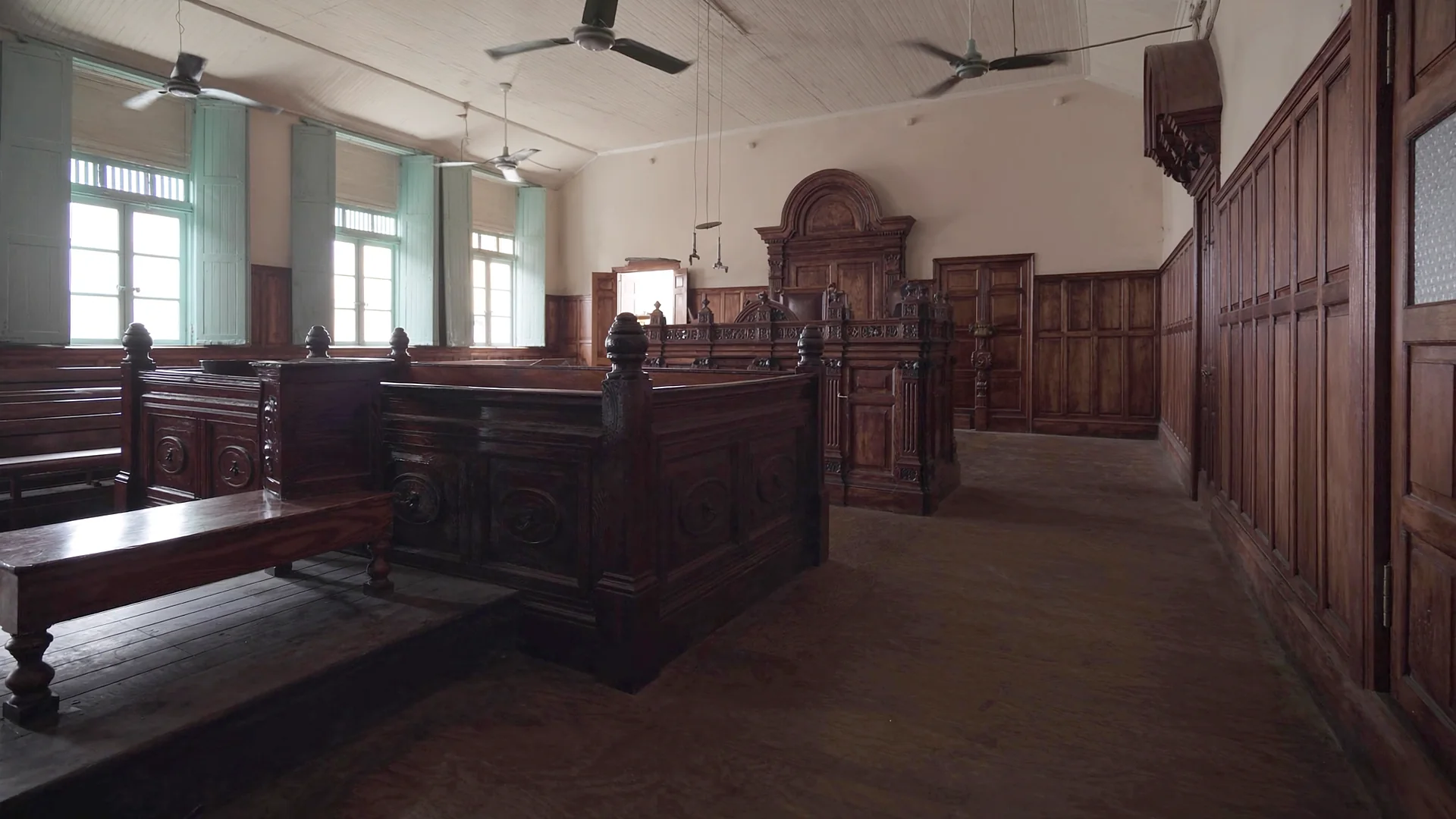
A dock statement is an unsworn account the accused gives from the dock after the defence is called. Because the accused has not testified on oath or affirmation, prosecuting counsel cannot cross-examine him on it, yet Sri Lankan courts must treat the statement as evidence.
At the close of the prosecution case a Sri Lankan judge must do one of two things. Under section 200(1) of the Code of Criminal Procedure Act No. 15 of 1979, if the judge wholly discredits the prosecution evidence, or considers that it fails to establish the offence charged or any offence of which the accused might be convicted on the indictment, the judge records a verdict of acquittal. Otherwise the judge calls upon the accused for his defence.
What the accused does next is one of the most consequential decisions in a criminal trial, and one of the least understood outside the profession.
Three roads out of the close of the prosecution case
Section 200(2) deals with the accused who announces an intention not to adduce evidence. In that event prosecuting counsel may address the court a second time to sum up the evidence against him.
Section 201(1) deals with the accused who announces an intention to adduce evidence. He may then enter upon his defence, examine his witnesses, and sum up his case. Section 201(2) attaches the consequence: prosecuting counsel is entitled to cross-examine all the witnesses called by the defence to testify on oath or affirmation.
The dock statement sits between those two. The accused neither stays silent nor goes into the witness box. He speaks from the dock, unsworn. Because he has not testified on oath or affirmation, the cross-examination entitlement in section 201(2) does not reach him.
That is the whole of the controversy in one sentence. The accused gets to put his account before the court without submitting it to the test that every other account in the trial must pass.
Where the right comes from
No Sri Lankan statute creates the dock statement. Section 120(6) of the Evidence Ordinance makes an accused a competent witness in his own behalf, which is a different thing: it lets him testify on oath.
The route in is section 100 of the Evidence Ordinance, which provides that whenever a question of evidence arises in a judicial proceeding that is not provided for by the Ordinance or by any other law in force in Sri Lanka, the question is determined according to the English law of evidence for the time being. The unsworn statement from the dock was part of English practice, and it came to us through that door.
The consequences of forgetting this are not academic. In CA 110/2009, decided on 27 October 2011, a High Court judge in Ratnapura had held that a dock statement was obnoxious to the Evidence Ordinance and should not be considered as evidence at all. The Court of Appeal, Ranjith Silva J with Lecamwasam J agreeing, held that the judgment was per incuriam because the judge was unaware of section 100, observing that the position in England had been changed by statute rather than by judicial pronouncement. The court set the conviction aside and sent the case back for a retrial before a different judge.
It is evidence, subject to two infirmities
The Supreme Court restated the law in SC Appeal No. 36/2020, decided on 24 October 2025 before Wengappuli J, Priyantha Fernando J and Wijesundera J. The court put it in two lines: a dock statement is to be considered as evidence, subject to two infirmities, namely that it is not tested by cross-examination and that it is not made under oath.
The court traced that to Queen v Buddarakkitha Thera 63 NLR 433, quoting Basnayake CJ:
"The right of an accused person to make an unsworn statement from the dock is recognized in our law. That right would be of no value unless such a statement is treated as evidence on behalf of the accused subject however to the infirmity which attaches to statements that are unsworn and have not been tested by cross examination."
It then set out the directions from Queen v Kularatne 71 NLR 529, which remain the clearest statement of what a tribunal of fact must be told. If the unsworn statement is believed, it must be acted upon. If it raises a reasonable doubt about the prosecution case, the defence must succeed. And it is not to be used against a co-accused.
A note on the citation, because it matters if you are pulling the report. The headnote in Sarath gives Kularatne as 71 NLR 551. Both the Supreme Court in 2025 and the Court of Appeal in 2011 give it as 71 NLR 529.
The Court of Appeal has said the same
In a judgment delivered on 24 March 2023 in CA/HCC/0214-215/2014, an appeal from the High Court of Negombo, Kumararatnam J put it directly:
"Treating unsworn statement of an accused from dock as evidence has been recognised and consistently followed in our courts despite the fact that statement not being subjected to cross examination. It has to be treated as other evidence which had been subjected to cross examination."
The court relied on Kathubdeen v Republic of Sri Lanka [1998] 3 SLR 10, quoting it as follows:
"It is settled law that an unsworn statement must be treated as evidence. It has also been laid down that if the unsworn statement creates a reasonable doubt in the prosecution case or if it is believed, then the accused should be given the benefit of that doubt."
So the position is not that a dock statement is worthless. It is that it goes into the scales with everything else, and that it can be enough on its own to raise the reasonable doubt that decides the case.
But it cannot be read on its own
The leading authority on how a judge should handle it is Sarath v Attorney General (2006) 3 Sri LR 96, a decision of the Court of Appeal (Balapatabendi J and Basnayake J) delivered on 9 March 2006. The appellant had been convicted of murder and complained that the trial judge considered his dock statement before turning to the prosecution evidence, which he said undermined the presumption of innocence.
The court held three things.
- A judge writing a judgment must have in mind the presumption of innocence, the accused's right to remain silent, and the burden on the prosecution to prove its case beyond reasonable doubt, which stays with the prosecution throughout.
- There is no rule that any particular item of evidence must be considered first, and no prescribed sequence for analysing evidence. Because the judgment analysed the whole of the evidence together, considering the dock statement at the beginning made no difference.
- A dock statement cannot be considered in isolation. The judge who heard the evidence is aware of the prosecution case and will always weigh the dock statement against the prosecution story.
Eric Basnayake J expressed the point plainly: "There is no rule to say what a judge should consider first and what should be considered last., judges use their inimitable styles in their judgment writing."
The judgment considered a line of earlier authority including R v Piyadasa 72 NLR 434, Gunapala and others v The Republic (1994) 3 Sri LR 180, James Silva v The Republic (1980) 2 Sri LR 167, Queen v Jayasena 72 NLR 313 (PC), Queen v Kularatne 71 NLR 551 and Somasiri v Attorney General (1983) 2 Sri LR 225.
A tension the cases have not resolved
There is a real difficulty running through this line of authority, and it is worth naming rather than smoothing over.
Sarath holds that a dock statement cannot be considered in isolation, and that the judge will always weigh it against the prosecution story. But in CA 110/2009 the Court of Appeal quoted Kamal Addararachchi (2002) 1 Sri LR 312, where Yapa J said that "to examine the evidence of the accused in the light of the evidence of the prosecution witnesses is to reverse the presumption of innocence". The same court also referred to Jemis Silva v Republic of Sri Lanka (1980) 2 Sri LR 167.
Those two propositions are not easy to hold together. One says the dock statement must be read against the prosecution case; the other warns that reading the defence account in the light of the prosecution evidence inverts the burden. In practice the reconciliation is probably that a judge may consider the whole of the evidence together, but may not treat the prosecution case as the yardstick against which the accused must prove himself. That is a distinction easier to state than to apply, and it is where many of these appeals are actually fought.
Speaking from the dock can open the door to rebuttal
One consequence of making a dock statement is often overlooked. Section 202 of the Code of Criminal Procedure Act provides that if any evidence is adduced on behalf of the accused, prosecuting counsel may, with the leave of the judge, call witnesses in rebuttal.
That is exactly what happened in the 2025 Supreme Court case. The accused said from the dock that he had not been arrested where the officers claimed and that his phone was taken from his home. The prosecution applied to lead rebuttal evidence, the defence did not object, and the officer was recalled to explain how the accused had received calls after the alleged arrest. His answer, that the phone had been handed back for surveillance purposes, was undermined in cross-examination because he had recorded the phone as having been taken into custody as a personal belonging.
The limit on that power is real. The Supreme Court cited Hildon v Munaweera 3 Sri LR 220 for the proposition that a party cannot lead evidence in rebuttal as of right, and that it is permitted only to counter unexpected or decisive evidence introduced by the opposing party. An objection is therefore available, and in that case none was taken.
Why judgments must give reasons
Appeals of this kind are usually argued as a complaint about the judgment rather than about the verdict, and the provision that makes that possible is section 283. It applies to judgments of courts other than the Supreme Court and the Court of Appeal, and it requires that the judgment be written by the judge who heard the case, dated and signed by him in open court at the time of pronouncing it, and, where an appeal lies, that it contain the point or points for determination, the decision on them, and the reasons for the decision.
That obligation to give reasons is what allows an appellate court to ask whether the dock statement was evaluated at all. Section 283 is a judgment-writing provision, not the source of the right to make a dock statement.
What makes a dock statement weak
The 2023 Negombo appeal is instructive on the practical side, because the trial judge rejected the dock statement and the Court of Appeal held he was entitled to.
The accused had said from the dock that on the day in question he was at home with his two children. The difficulty was that this account appeared for the first time in the dock. It had never been put to the prosecution witnesses in cross-examination, and no suggestion to that effect had been made. The trial judge treated it as a new position taken up from the dock and declined to accept it, and that reasoning survived appeal.
There is a lesson in that which has nothing to do with the dock statement itself. An account that the defence intends to rely on must be put to the prosecution witnesses when they are in the box. A defence advanced for the first time after the prosecution has closed invites the inference that it was constructed to meet the evidence.
The same appeal produced a point in the accused's favour. Counsel argued that the trial judge had wrongly rejected the dock statement by applying the Lucas principle, the rule concerning lies told by an accused. The Additional Solicitor General accepted that the Lucas principle was not appropriate in that case, and the court agreed that the ground had merit. Rejecting a dock statement is not a matter of reaching for any convenient principle.
How the choice is actually made
Reduced to its elements, the accused has three options once the defence is called, and each carries a cost:
- Remain silent. Nothing is added to the defence case, and under section 200(2) prosecuting counsel gets a second address to the court.
- Give sworn evidence. The account carries the weight of tested testimony, but the accused is exposed to cross-examination on it under section 201(2), including on any previous convictions or inconsistencies that become admissible.
- Make a dock statement. The account goes before the court and must be treated as evidence, but it has not been tested, and a court weighing it against cross-examined prosecution evidence will say so.
The decision belongs to the client, on advice. What the case law shows is that the choice is not between a real defence and an empty gesture. A dock statement that is specific, consistent with what was put in cross-examination, and capable of raising a doubt can do real work. A bare denial produced for the first time in the dock generally cannot.
Practical points
- Put the defence case to the prosecution witnesses. An account first raised from the dock is the most common reason a dock statement is rejected.
- A dock statement must be treated as evidence, and if it raises a reasonable doubt the accused takes the benefit of it.
- It cannot be assessed on its own, so it should be framed against the prosecution case rather than in the abstract.
- On appeal, the section 283 duty to give reasons is the route to arguing that the statement was never properly evaluated.
- The choice between silence, sworn evidence and a dock statement should be taken deliberately and recorded, not left to the moment the defence is called.
The dock statement is an unusual survival. It lets an accused speak to the court without the ordeal of cross-examination, and Sri Lankan courts have declined to treat that as a reason to ignore what he says. What they have insisted on is that it be weighed, in context, against everything else in the case, and that the judge explain what he made of it.