

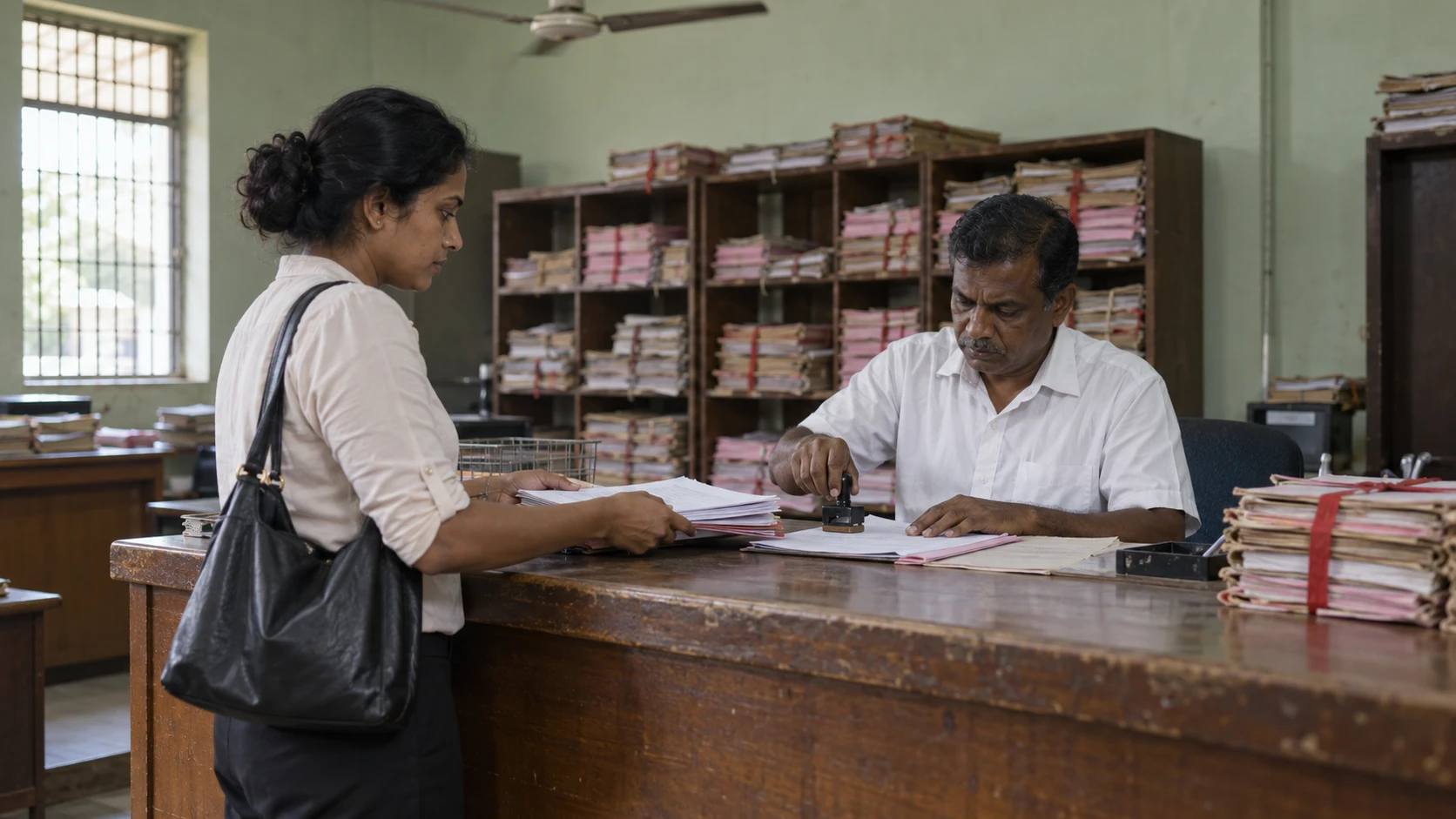
The Small Claims Court hears claims for money and movable property up to Rs 2,000,000, excluding interest. It is the District Court sitting in a different capacity, and for claims below Rs 1,000,000 a Mediation Board has to see the dispute before a court will entertain it.
Sri Lanka spent a long time without a forum proportionate to a modest dispute. A claim for a few hundred thousand rupees went into the same District Court queue as everything else, on the same pleadings and at the same pace, which meant that for a great many people the cost of recovery exceeded what was being recovered. The Small Claims Court is the answer to that, and it is a better answer than it is usually given credit for. Whether it helps you turns on two questions that have nothing to do with the merits of your claim.
Where the court comes from
The Judicature (Amendment) Act No. 34 of 2022 inserted Chapter VA into the Judicature Act No. 2 of 1978, creating the Small Claims Court and setting out its jurisdiction in sections 29A to 29E. By the Minister's Order the amending Act came into force on 1 January 2023. The procedure is separate, and is found in the Small Claims Courts' Procedure Act No. 33 of 2022, certified on 17 November 2022 and brought into operation on 1 January 2023 by an Order in the same Gazette, Extraordinary No. 2310/40 of 15 December 2022. Both Acts are in force.
The first thing to understand is that no new courthouse was built for this. Section 5(1) of the Judicature Act provides that the District Court is deemed to be the Small Claims Court when exercising the jurisdiction vested in a Small Claims Court, in the same way that it is deemed to be the Family Court when exercising that jurisdiction. The judge sits as a Judge of the Small Claims Court, and section 8 allows additional judges to be appointed to it.
What it can hear
Section 29A(1) gives the Small Claims Court exclusive original civil jurisdiction over the actions listed in the Seventh Schedule to the Judicature Act. Section 29A(2) caps them at a sum excluding interest and allows the Minister to fix a different one, and section 29A(3) provides that such an Order has no effect until Parliament approves it and the approval is notified in the Gazette.
That machinery has already been used, and the result is the most commonly misstated fact about this court. The Act was passed with a limit of Rs 1,500,000. The Minister raised it to Rs 2,000,000 by Order in Gazette Extraordinary No. 2328/16 of 21 April 2023, Parliament approved the Order on 3 October 2023, and the approval was notified, as section 29A(3) requires, in Gazette Extraordinary No. 2354/21 of 19 October 2023. Almost every published account still gives the figure as Rs 1.5 million, including reporting that post-dates the approval. It is Rs 2 million.
| Item | What it covers |
|---|---|
| 1 | Any action for the recovery of money, as a debt, fee, payment, damage or demand, including damages for accident or personal injury or any similar category |
| 2 | Any action for the recovery of movable property |
| 3 | Any counterclaim in respect of a cause of action in items 1 and 2 |
| 4 | Any other jurisdiction conferred by any other law |
Item 1 is wider than people expect. It is not confined to contract debts: a claim in damages arising out of a road accident or a personal injury falls squarely within it, provided the sum is within the limit.
What it cannot hear, even under the cap
Two exclusions catch people out, and both are expressed to apply however small the claim is. The proviso to section 29A(1), repeated in section 2 of the Procedure Act, removes from the Small Claims Court any action filed under Chapter LIII of the Civil Procedure Code, which is the summary procedure on liquid claims, and any action for the recovery of money for which special provision is made under another written law. The Procedure Act puts it beyond argument by adding that this holds even where the value of the cause of action is less than the prescribed sum.
That second limb does a lot of work in practice. A great many money claims in Sri Lanka are brought under a statute with its own recovery machinery, and those stay where that statute puts them.
Where the claim is slightly above Rs 2,000,000, section 4 of the Procedure Act allows the plaintiff to abandon or relinquish part of it in order to come within the jurisdiction, provided an averment to that effect appears in the plaint. That is a real choice with a real cost, and it should be made deliberately rather than discovered late.
The mediation gate, which is the thing most people miss
This is the provision that decides whether the Small Claims Court is available to you at all, and it is not in either of the 2022 Acts.
Section 7(1) of the Mediation Board Act No. 72 of 1988 provides that no proceeding shall be instituted in, or entertained by, a court of first instance where the dispute relates to movable or immovable property, or to a debt, damage or demand, below a monetary threshold. That threshold was Rs 25,000 when the Act was passed. It went to Rs 250,000 by the amendment of 2011, to Rs 500,000 by that of 2016, and to Rs 1,000,000 by the Mediation Board (Amendment) Act, No. 2 of 2024, which was certified on 23 January 2024 and carries no separate commencement provision. The dispute must first go to a Community Mediation Board, and the action can be filed only once the Board has issued a report under section 12(2) or a certificate of non-settlement under section 14A. The 2024 Act also inserted section 7(1A), which for the first time lets the Minister change the figure by regulation rather than by amending Act; no such regulation has been made, so Rs 1,000,000 stands.
Set the two figures side by side. The Small Claims Court reaches Rs 2,000,000. The mediation bar catches everything below Rs 1,000,000. So the lower half of the small claims range cannot be filed as a plaint at all until the Board has dealt with it, while claims between Rs 1,000,000 and Rs 2,000,000 go straight in. A claimant at the lower end who files first will meet the bar rather than the merits.
Three qualifications matter. The Third Schedule exempts fifteen categories of cause of action, and it is a carve-out from limb (b) of section 7(1) rather than from the section as a whole, so the first question is always whether the particular cause of action is on that list. Section 6(2) puts certain disputes, including those to which the State or a public officer is a party, outside the jurisdiction of a Mediation Board altogether. And the proviso to section 7(1) preserves access to the court where the relief sought includes a provisional remedy under Part V of the Civil Procedure Code, though the court may then deal only with the provisional remedy and must refer the dispute to mediation afterwards.
One caution about all of this. Neither of the 2022 Acts amends the Mediation Board Act, and section 2 of the Procedure Act is expressly subject to any pecuniary or other limitation imposed by any written law, so the gate applies on the face of the statutes. We have found no reported decision or judicial circular on how the two regimes interact, so it should be treated as the position the text produces rather than as settled authority.
None of this is a criticism of the design. Mediation before a Board is free, local and quick, and on the reported figures it settles a substantial proportion of what reaches it. But it is a step, it takes time, and it is not optional.
Why the procedure is genuinely faster
The Procedure Act is not the Civil Procedure Code with the deadlines shortened. It removes stages.
- The plaint goes in on Form No. 1, and section 8 requires the plaintiff to file an affidavit supporting the facts and to produce the instrument sued upon and every other document relied on, at the same time.
- Summons issues on Form No. 2. If the defendant admits the claim on the returnable day, section 10 has the court enter judgment on the admission there and then, the admission signed by the defendant and attested by an Attorney-at-Law.
- If not, section 11(3) requires the answer within one month of appearance, with affidavits and documents attached, and provides that no further time shall be granted save in appropriate circumstances.
- Pleadings close at the answer unless there is a claim in reconvention, in which case a replication may be permitted. Section 6 allows nothing beyond that.
- Section 21(1) requires a settlement date to be fixed within four weeks of pleadings closing, and makes it the court's duty to try to settle the case.
- If it does not settle, the matter is fixed for trial, but section 23(2) provides that the affidavits filed with the pleadings stand as the evidence in chief. Additional evidence is admitted only on the narrow grounds in section 23(2)(a) to (d).
- Section 23(1) removes the requirement to record issues, unless the court considers that special matters require it. Section 22(2) disapplies the pre-trial procedure in Chapter XVIIA of the Civil Procedure Code, and section 19 disapplies interrogatories.
- Section 25 provides that a document need not be proved unless its genuineness is impeached, and that a party who impeaches a document unsuccessfully pays the costs of proving it, in addition to taxed costs.
- Section 27 requires proceedings to be concluded as expeditiously as possible, and sets an express target of eighteen months from commencement unless the judge records reasons.
Two of those deserve emphasis because they change how a case is prepared. Affidavit evidence in chief means the case is effectively built before it is filed, not developed as it goes: the documents and the witness account have to be assembled first. And section 16 allows amendment of pleadings only where the court is satisfied that grave and irremediable injustice would otherwise be caused, and on no other ground. A pleading error that would be corrected as a matter of course in the District Court may be uncorrectable here.
Against that, section 31(2) provides that no proceeding is invalidated on account of technicalities in procedure or a formal defect in the pleadings, affidavits or forms, and directs the judge to ensure that technicalities do not impede justice. The two provisions are aimed at different things: section 16 stops a party rewriting their case, section 31(2) stops the other party winning on a typographical point.
Settlement is the judge's duty, not a suggestion
Section 29E of the Judicature Act makes it the duty of the judge, by all lawful means, to make every effort to induce the parties to settle, before or during the trial, and to record and enter judgment on any settlement reached. Section 21(1) of the Procedure Act gives that duty a date in the timetable, and costs may be ordered against a party who fails to attend the settlement date in person without sufficient cause.
A party who treats the settlement date as a formality is therefore taking a costs risk in a forum where the sums in dispute are small enough for costs to matter. Where the contract contains a mediation clause, the position under the Mediation Act should be considered as well.
Appeals
Section 29D of the Judicature Act and section 29 of the Procedure Act both provide the route. An appeal against a judgment lies to the High Court of the Province established by Article 154P of the Constitution, for an error of fact or of law. An appeal against an order, including an order setting aside or refusing to set aside a judgment entered on default, lies to the same court but requires leave first obtained.
Section 29(4) of the Procedure Act requires an application for leave, or a final appeal, to be heard and concluded within twelve months, unless the judge records reasons. Taken with the eighteen-month target at first instance, the design contemplates a claim being finished, appeal included, inside two and a half years.
Where the court actually sits
This is the part that decides whether any of the above is available to you, and it is the least written about.
Twenty-five Small Claims Courts were planned, for Colombo, Gampaha, Galle, Matara, Kaduwela, Kandy, Anuradhapura, Jaffna and other principal towns. They were to be operating from 1 January 2023. Reporting in October 2023 recorded one functioning, in Colombo, with buildings, equipment and trained personnel given as the reasons the others had not opened. Work on a model court at Kandy was reported during 2024, supported through a justice sector programme.
There is one current datum. The District Court of Colombo notices a Small Claims Court established at No. 48, Gregory's Road, Colombo 7 on 11 June 2026 under the Procedure Act. Beyond that we have found no published figure for how many are operating nationally, and anyone relying on this should confirm locally rather than assume. The point for a prospective claimant is narrower and does not depend on the exact number: the jurisdiction exists island-wide as a matter of statute, because every District Court is deemed to be a Small Claims Court, but the dedicated court with its own judge and list is not yet everywhere it was intended to be. Ask the District Court registry in the relevant district before planning a timetable around the eighteen-month target.
Practical points
- Work out the mediation question first. If the debt, damage or demand is below Rs 1,000,000 and the cause of action is not in the Third Schedule to the Mediation Board Act, the Board's report or certificate is a precondition, not a formality.
- Check the limit before pleading. It has been Rs 2,000,000 since Parliament approved the Minister's Order in October 2023, and most published guidance still says Rs 1,500,000.
- Assemble the evidence before filing, not after. The affidavit filed with the plaint is the evidence in chief, and section 23(2) admits more only on narrow grounds.
- Check whether the claim is one for which another statute makes special provision for recovery of money. If it is, the Small Claims Court has no jurisdiction however modest the sum.
- Where the claim is just over Rs 2,000,000, section 4 of the Procedure Act allows part of it to be abandoned to come within jurisdiction. Price that against what is given up before doing it.
- A counterclaim above the cap does not defeat the action. Section 14 of the Procedure Act allows the court to hear it and enter decree, to avoid multiplicity of actions.
- If the action is filed in the wrong court, section 5 of the Procedure Act applies section 47 of the Civil Procedure Code and excludes the period between institution and return of the plaint from the computation of prescription, which protects a claim that would otherwise have become time-barred.
For larger or more complex recoveries the ordinary route still applies, and the considerations are set out in recovering a commercial debt in Sri Lanka. Where the question is which court a matter belongs in at all, how Sri Lanka's court system works sets out the structure.