
Emigrating to Australia is two legal problems, not one. The Australian half is regulated in Australia and belongs to a registered migration agent or an Australian legal practitioner. The Sri Lankan half belongs to nobody in Australia at all.
The Australian Bureau of Statistics counted 184,800 Sri Lanka-born people living in Australia at 30 June 2025, and at the 2021 Census 52 per cent of that population was in Victoria. A steady proportion of them find at some point that something in Sri Lanka needs a Sri Lankan lawyer. A parent dies and there is land. A sibling will not sell. A child born in Melbourne turns out never to have been registered. A summons arrives from a court in Colombo. A bank wants a power of attorney that expired two years ago.
This page is for both groups: people still in Sri Lanka who can settle these things cheaply before they go, and people already in Australia dealing with them the hard way. The Australian side of the move is in Australian permanent residence for Sri Lankans.
If you are already in Australia
Most of what follows is easier before you leave, but very little of it is impossible afterwards, and almost none of it requires you to fly back. A Sri Lankan matter can be run from Melbourne or Perth on a properly drawn power of attorney and instructions to counsel here, which is set out in instructing Sri Lankan counsel from abroad.
These are the problems the diaspora actually brings, and where each one is dealt with.
- A parent has died and there is property or money in Sri Lanka: wills and succession in Sri Lanka.
- A sibling is living in the family house and will not sell: when a co-owner will not sell.
- Land has been transferred while you were overseas, without your knowledge: property transferred without your consent.
- You have been sued in Sri Lanka and you are not there: being sued in Sri Lanka while you live abroad.
- You divorced in Australia and need it recognised here, or you want to divorce from there: is your Australian divorce valid in Sri Lanka and divorcing in Sri Lanka from abroad.
- Your child was born in Australia and the birth was never registered: an unregistered birth abroad.
- You need a document signed in Australia to work in Sri Lanka: signing documents abroad for use in Sri Lanka.
- You have an Australian judgment you want enforced here: enforcing Commonwealth judgments in Sri Lanka.
Five things that surface years later
In the order in which they tend to go wrong.
Citizenship is the first. A Sri Lankan who acquires another nationality can lose Sri Lankan citizenship by operation of law. The route back is resumption, which is discretionary and carries its own criteria and fees, and retention before naturalising is a different provision again, applied for before the loss rather than after it. The sequence decides which provision applies to you, so this is a decision to take before you naturalise abroad rather than after. The distinctions are set out in dual citizenship and the citizenship of children born abroad.
Children are the second, and the mistake is close to universal. Sri Lankan citizenship does not pass automatically to a child born overseas. Registration of the birth is what creates the citizenship, and an unregistered birth abroad produces no citizen at all. Families emigrate, have children there, intend to register the births later, and discover decades on that the window has closed and the remaining routes are discretionary.
Property is the third. Land held in Sri Lanka when citizenship status changes raises questions about what may be held and on what terms, and those questions are far easier answered before the change than after. The general position for non-citizens is in buying property in Sri Lanka as a foreigner.
Money is the fourth. Provident fund balances, bank accounts and the proceeds of any later sale have to leave through the lawful exchange control route, and the applicable allowances and account types change on a short cycle. People who assume the money will simply follow them are the people who later describe it as trapped.
Documents are the fifth. Sri Lanka is not a party to the Apostille Convention, so a document executed in Australia for use here takes a different route from the one an Australian lawyer will assume, and the powers of attorney families rely on to manage affairs from abroad are valid for five years by default, unless the instrument itself specifies a period, and carry a registration deadline of three months where executed abroad. That is dealt with in signing documents abroad for use in Sri Lanka.
There is a sixth for anyone leaving litigation behind. A case does not pause because you have emigrated, and being sued in Sri Lanka while living abroad is a more common experience than most people expect. The practical mechanics of running a Sri Lankan matter from overseas are in instructing Sri Lankan counsel from abroad.
Documents, and the problems they cause
Australian processes assume a documentary record that is internally consistent. Sri Lankan records frequently are not, for entirely innocent reasons, and this is where a Colombo practice can do work that no Australian adviser can.
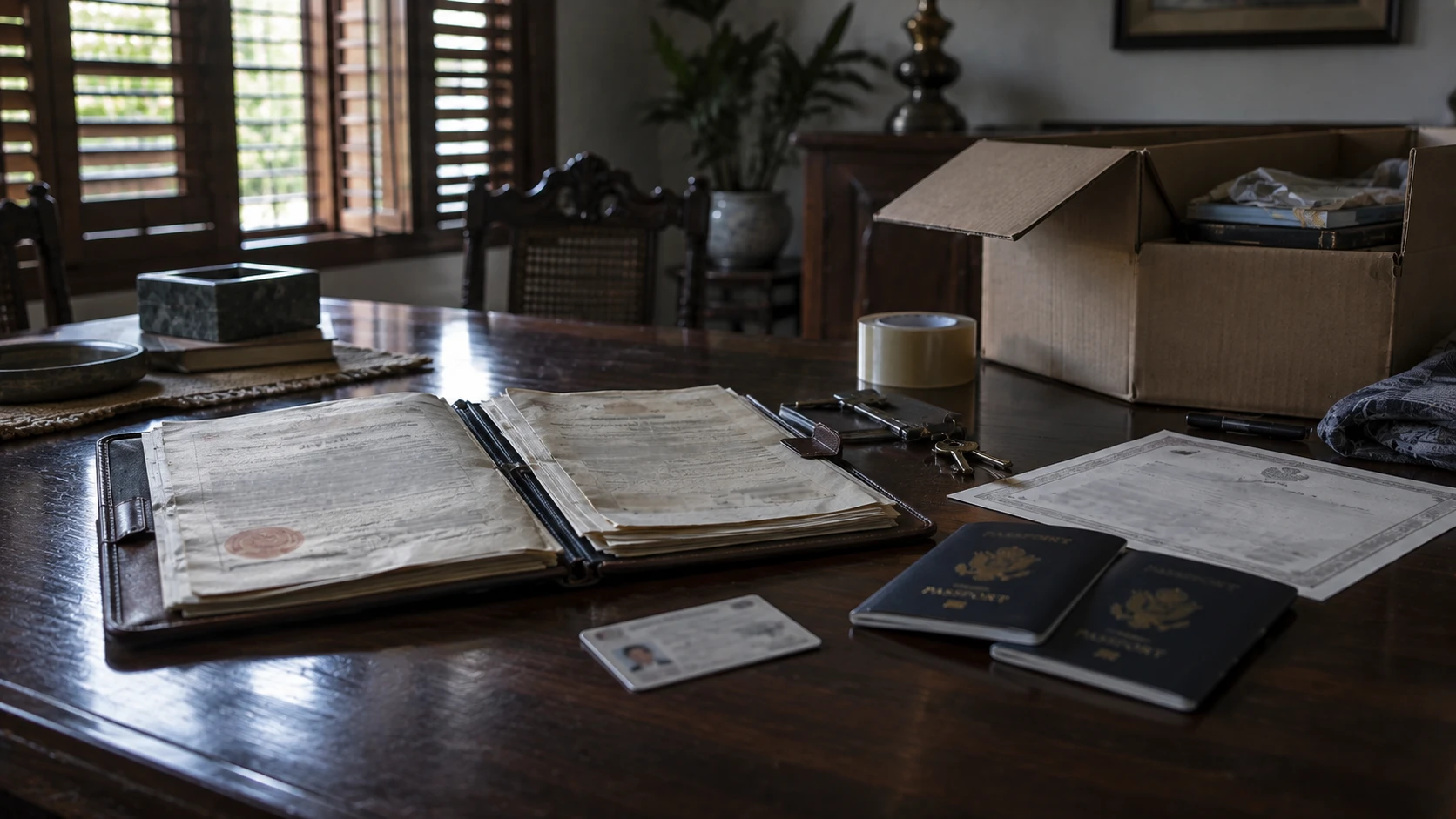
The commonest problem is the name. A single person's name can appear differently on a birth certificate, a National Identity Card, a passport, a marriage certificate, a degree and an employment record, through initials against expanded names, Sinhala or Tamil transliteration variants, a changed order of names, or a change on marriage. Every one of those will read to an assessing authority or to the Department as a discrepancy requiring explanation.
The two wrong responses are to hope nobody notices and to quietly amend one document so it matches another. The second is worse than the first. The right response is to establish, from the underlying civil records and where necessary by a properly sworn affidavit, that the differently recorded names belong to one person. An affidavit does not fix a discrepancy by itself; it evidences an explanation that the underlying records support. Where the records do not support it, the answer is to correct the record through the proper route rather than to swear around it.
Translations are the second problem. Documents in Sinhala or Tamil will need English translations, and the standard expected of a translation and of its certification is not the same everywhere. Getting this wrong wastes a lodgement rather than merely delaying it.
Employment evidence is the third, and it decides skills assessments more often than qualifications do. A service letter confirming that somebody worked somewhere between two dates is rarely enough. Assessors want the duties actually performed, and they will read a job title against a description. Appointment letters, detailed service letters, payslips, Employees' Provident Fund and Employees' Trust Fund records, tax documents, contracts and professional registrations all carry weight. All of them are far easier to obtain while you are still in Sri Lanka and still in touch with former employers, and close to impossible to chase from Melbourne five years later.
The fourth is the older record. Birth, marriage, divorce and death certificates, court records, deeds and land registry extracts can all be obtained, and the process is ordinary Sri Lankan legal work. It takes time, which is the reason to start it before a deadline is running.
Three practical points for an applicant in Colombo.
On character, there are two different positions and most articles give only one of them. The Department's general character page sets no universal test and frames police certificates as something it requests, usually after lodgement. The document checklists for the skilled visas do require them upfront: the Department must be given police certificates for the applicant and family members aged over 16, from every country in which they have lived for twelve months or more in the past ten years since turning sixteen. That count includes time lived in Australia.
So the answer depends on the visa you are lodging. Read the checklist for that subclass rather than a general rule, and do not obtain certificates speculatively: they have a currency period and one obtained early can expire before it is used.
On health, migration medical examinations are conducted by panel physicians rather than by any doctor, and the International Organization for Migration operates as a panel physician in Sri Lanka. For some subclasses the Department's My Health Declarations service allows an examination to be completed before lodging, with a health identifier issued upfront; for others the Department asks after lodgement.
On biometrics, Sri Lanka has two Australian Biometrics Collection Centres, at Colombo and Jaffna, operated under contract by VFS Global. They take a digital facial image and scan all ten fingertips.
Since 24 March 2026 Sri Lanka has also been among the countries where eligible applicants may use the Australian Immi App, one of thirteen added in that tranche, bringing the total to 47 under the Offshore Biometric Collection Program. It needs describing precisely, because in Colombo it is being described as something it is not.
It submits two things: your passport details and a live facial image. It does not take fingerprints. To use it you must already have provided biometrics, face and fingerprints, to the Department on an earlier occasion, hold a valid passport, and hold a letter requiring personal identifiers with a visa lodgement number beginning AUI. The Department decides and tells you which route to use. If your lodgement number does not begin AUI, if you have never been enrolled, or if the app cannot capture an acceptable photograph, you attend a collection centre.
So the app is a convenience in how an identity check is submitted. It confers no eligibility, no priority, no fee reduction and nothing specific to Sri Lanka. Anyone presenting it as an Australian concession to Sri Lankans is inventing one.
The Australian High Commission in Colombo adds one further caution: the Department does not recommend the use of unregistered third parties for lodging applications.
The order this usually has to happen in
A sequence rather than a set of instructions, because which parts apply to any particular family depends on facts this page cannot know.
- Australian migration advice comes from a registered migration agent or an Australian legal practitioner, and registration can be checked before any money changes hands. Nobody in Sri Lanka can lawfully give it.
- Sri Lankan employment evidence is far easier obtained while a person is still in the country and the former employer still exists. Detailed service letters describing duties, appointment letters, payslips, provident and trust fund records, tax documents and professional registrations all carry weight.
- Names across a birth certificate, a National Identity Card, a passport, a marriage certificate, degrees and employment records are reconciled through the underlying civil records rather than around them.
- The Sri Lankan citizenship position is decided by the sequence of naturalising and applying, so it is settled before naturalisation rather than after.
- A child born overseas has a registration deadline, and it is the single most common omission in the diaspora.
- Land, accounts and any live litigation in Sri Lanka are simpler to arrange while a person is still resident, and a power of attorney put in place on the current rules has a diary date attached to it.
What this is not
General information about Sri Lankan law, current as at 18 September 2026. It is not Australian immigration assistance, which is regulated under the Migration Act 1958 and reserved to registered migration agents and Australian legal practitioners. This firm is admitted in Sri Lanka and is neither, and nothing here is advice about an Australian visa application.
What it is about is Sri Lankan legal work, which this firm does: affidavits and declarations, notarial and certification work, powers of attorney, civil-status and court documentation, obtaining and reconciling Sri Lankan records, property matters, probate and inheritance, family matters, corporate matters and litigation. If you are in the middle of an Australian application and something Sri Lankan is holding it up, that is the part to bring here.
AW Chambers acts as Sri Lankan local counsel for firms and clients abroad on matters of this kind: research, drafting, appearances and enforcement, instructed from London, Singapore and Australia. How that works, and what a first brief should contain, is set out on the international litigation support page.